


To calm anxiety at home, slow your breathing, ground yourself in the present, take one small action, question the anxious thought, and reach out or journal. These therapist-informed coping skills settle your nervous system fast. When anxiety keeps disrupting your life, therapy can help.
You’re Not Alone: Real Anxiety Relief Starts Here
It’s midnight in Plymouth, the house is finally quiet, and your mind picks that exact moment to replay a conversation you can’t take back. Or your chest tightens in the school pickup line, your jaw clenches before you open your inbox, and the workday hasn’t even started. If that rhythm feels familiar, you’re not broken, and you’re far from alone.
We’re Breaking Dawn Therapy, an adult-focused practice rooted in Plymouth, Michigan. We help busy professionals, parents, and overwhelmed adults across Southeast Michigan build practical skills that quiet worry and bring back a sense of steadiness. This therapist-written guide gives you five strategies you can use, plus a clear, compassionate sense of when it may be time for more support.
Why Anxiety Feels So Intense at Home
Home should feel like your safe place, so why does anxiety often get louder once the day slows down? The answer lives in your nervous system.
When your brain senses a threat, real or imagined, it flips into fight-or-flight mode. Your heart races, your breathing turns shallow, and your muscles tense. That response protects you from actual danger. It exhausts you when the “threat” is an unanswered email or a worry about next week.
Two habits keep anxiety spinning. The first is rumination, replaying the same worry on a loop without ever resolving it. The second is avoidance, dodging the thing that scares you, feeling brief relief, and watching the fear quietly grow.
Anxiety also leans on catastrophic thinking. That’s when your mind treats the worst-case scenario as the most likely one. The National Institute of Mental Health reports that roughly a third of U.S. adults experience an anxiety disorder at some point. So if your brain works this way, you have plenty of company, and real tools to shift the pattern.
5 Everyday Strategies to Calm Anxiety at Home
These anxiety coping skills work because they steady your body and your thoughts at the same time. Pick one, try it, and notice what shifts. Small, consistent practice beats a perfect routine every time.
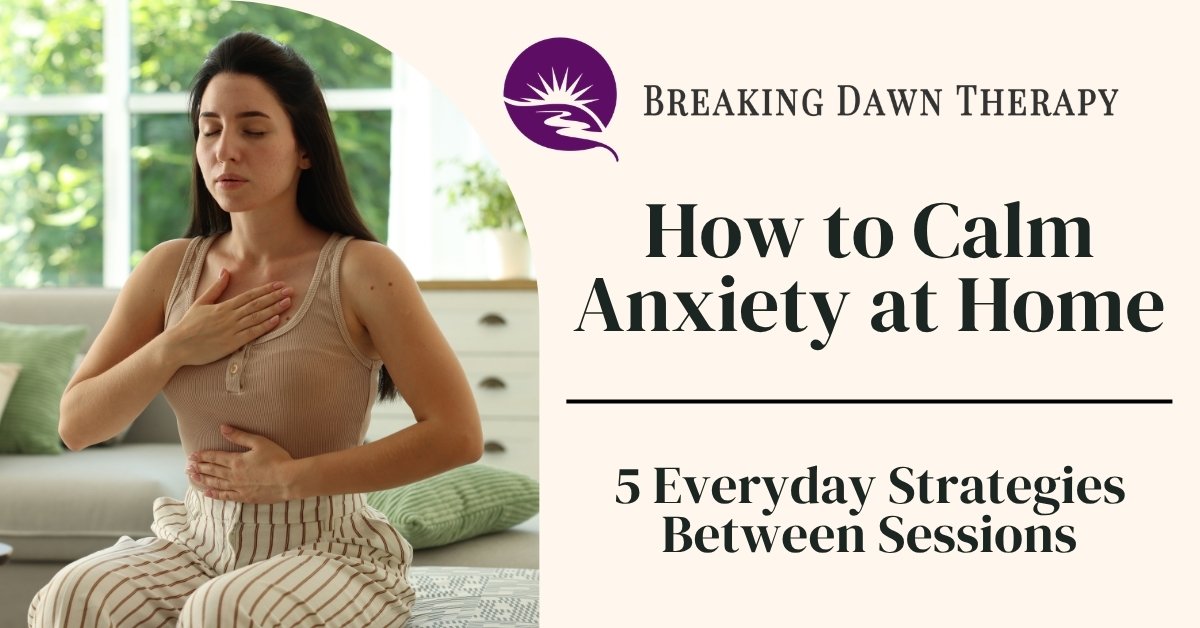
1. Steady Your Breath with Paced Breathing
What it looks like: Your heart pounds, your breathing goes fast and shallow, and a wave of panic builds out of nowhere.
What to do: Try box breathing. Inhale for four counts, hold for four, exhale for four, and hold for four. Repeat for one to two minutes.
Why it works: Slow, deliberate breathing signals your nervous system to shift out of fight-or-flight and back toward calm. Your exhale does most of the heavy lifting, so make it slow and full.
Real life: Picture a parent in Canton feeling panic climb before school pickup. Two quiet minutes of paced breathing in the car can settle a racing heart before the doors open.
Best-use note: This is one of the fastest coping skills for anxiety attacks. Keep it close, because your breath goes everywhere you do.
2. Ground Yourself in the Present Moment
What it looks like: Your thoughts spin through “what ifs,” and you feel foggy, detached, or miles away from the room you’re in.
What to do: Use the 5-4-3-2-1 method. Name five things you see, four you can touch, three you hear, two you smell, and one you taste.
Why it works: Grounding exercises pull your attention out of imagined futures and back into the present, which interrupts the worry loop your brain gets stuck in.
Real life: A busy professional in Northville might use this at their desk when a looming deadline sparks dread. Naming what’s real reminds the nervous system that right now, in this moment, you’re safe.
Best-use note: Move slowly and let each sense fully register. Rushing the list defeats the purpose.
3. Take One Small Action to Break Avoidance
What it looks like: A task feels so heavy that you keep putting it off, and the dread grows larger with every hour it waits.
What to do: Skip the whole overwhelming project. Do one small piece instead. Answer a single email, wash one dish, or walk to the mailbox.
Why it works: This is behavioral activation, and it reverses the avoidance cycle. Each small action proves the feared task is survivable and rebuilds your momentum.
Real life: An overwhelmed adult staring at a messy kitchen might just wipe one counter. That single step often unlocks the energy for the next.
Best-use note: Pair it with movement when you can. The Anxiety and Depression Association of America notes that regular activity, even a brisk walk, meaningfully reduces anxiety and stress.
4. Question the Anxious Thought
What it looks like: Your mind insists “I’ll fail” or “everyone’s judging me,” and you believe it like proven fact.
What to do: Pause and check the evidence. Ask yourself three questions. Is this thought actually true? What’s a more balanced way to see it? What would I tell a friend who felt this way?
Why it works: This skill comes straight from Cognitive Behavioral Therapy. You aren’t forcing fake positivity. You’re aiming for the truth, which is usually far kinder than anxiety’s version.
Real life: Before a big presentation, a professional might swap “I’m going to embarrass myself” for “I’ve prepared, and I can handle a few stumbles.” That shift eases the pressure right away.
Best-use note: Writing the thought down first makes it easier to challenge. Our simple, honest guide to CBT for anxiety walks through this skill in more depth.
5. Reach Out or Write It Down
What it looks like: You feel isolated, your head is cluttered, and the worry grows louder the longer you carry it alone.
What to do: Text a friend, call a family member, or tell someone you trust that you’re overwhelmed. If you’d rather process privately, spend five minutes journaling what’s swirling in your mind.
Why it works: Naming a worry out loud or on paper shrinks it. Connection reminds you that support exists, and journaling clears mental clutter so you can spot patterns.
Real life: A parent lying awake at midnight might jot down every looping worry, then set the notebook aside. Getting it out of your head often quiets the 2 a.m. spiral.
Best-use note: Late-night journaling works especially well for racing thoughts before sleep.
Your Quick-Reference Anxiety Toolkit
| Strategy | Best For | What to Do | Why It Helps | Good Between Sessions |
|---|---|---|---|---|
| Paced breathing | Panic, racing heart | Box breathing for one to two minutes | Calms the nervous system fast | Yes |
| Grounding | Spiraling thoughts, feeling detached | Name 5-4-3-2-1 sensory details | Anchors you in the present | Yes |
| Small action | Avoidance, dread, low motivation | Do one tiny step of a task | Breaks the avoidance cycle | Yes |
| Thought checking | Catastrophizing, self-doubt | Question the thought’s evidence | Replaces distortions with truth | Yes |
| Connection or journaling | Isolation, mental clutter | Talk to someone or write it out | Releases tension, reveals patterns | Yes |
What to Do Between Therapy Sessions When Anxiety Spikes
If you’re already in therapy, the days between appointments are where much of the real change happens. A little structure makes those days easier.
Keep a short list of the two or three strategies above that work best for you, and return to them the moment anxiety creeps in. You don’t have to reinvent the wheel in a hard moment.
Track your triggers, too. When worry spikes, jot down what happened, what you felt, and what helped. This turns vague overwhelm into useful information you and your therapist can work through together.
Above all, don’t judge yourself for a rough day. Notice the pattern, bring it to your next session, and let your therapist help you build on it.
When Anxiety Self-Help May Not Be Enough
These tools genuinely help, and sometimes they aren’t enough on their own. That’s not a failure. It’s simply useful information about what you need next.
Consider talking with a licensed therapist if you notice:
- Worry that feels constant or impossible to control
- Avoiding people, places, or tasks you used to handle with ease
- Trouble sleeping, relaxing, or concentrating
- Physical symptoms like tension, fatigue, or a racing heart
- Relief that fades fast, leaving you stuck between good days
Please hear this clearly. You don’t have to be in crisis to deserve support. Reaching out early is a sign of strength, and the sooner you start, the sooner anxiety loosens its grip.
How Breaking Dawn Therapy Can Help
Broad wellness lists tell you to breathe and exercise, then leave you guessing about everything else. We do things differently. When self-help stops being enough, structured, therapist-led care fills the gap that generic advice can’t.
You work directly with one consistent licensed therapist who learns your story, your goals, and your progress, not a rotating roster on a national platform. That continuity is what makes therapy work.
Our care draws on Cognitive Behavioral Therapy, a proven, short-term approach the American Psychological Association reports is as effective as, or more effective than, medication for many people with anxiety. Explore our anxiety therapy services to see how we tailor care to your goals.
You choose the format that fits your life, too. We offer secure virtual therapy across Michigan, reaching adults from Canton to Belleville to Ann Arbor, plus in-person sessions at our Plymouth office. Both options use the same evidence-based methods and the same caring therapist.
Our founder, Kristen Stewart, LMSW-C, earned bachelor’s and master’s degrees in social work from Wayne State University. She trained deeply in CBT across hospitals, clinics, and community agencies throughout Michigan, which means the guidance here comes from real clinical experience, not a generic template.
For many adults in Plymouth, Canton, Northville, and across Southeast Michigan, the hardest part is wondering whether what they feel is “serious enough” for therapy. It is. You deserve support that meets you exactly where you are.
Take the Next Step Toward Calmer Days | Schedule a Consultation With Breaking Dawn Therapy
Anxiety can be loud, but it doesn’t get the final word. Small, therapist-informed tools like breathing, grounding, and thought-checking can steady you tonight, and they work even better with a skilled guide in your corner.
You’ve carried this long enough on your own. When you’re ready, request an appointment or call us at (734) 457-1253. There’s no pressure and no obligation, just a warm conversation about what you need. Calmer days are closer than they feel right now, and the next step starts today.
Frequently Asked Questions About How to Calm Anxiety
1. How Do I Calm Anxiety at Home Fast?
Start with your breath. Slow, paced breathing for one to two minutes signals your nervous system to relax. Pair it with a grounding exercise, like naming five things you can see, to interrupt racing thoughts and pull you back into the present moment.
2. What Are the Best Coping Skills for Anxiety Attacks?
Paced breathing and grounding exercises work best during an anxiety attack. Focus on slow, full exhales, and anchor yourself in your surroundings using your senses. These skills calm your body quickly and remind you that the wave of panic will pass.
3. Can I Manage Anxiety at Home Without Therapy?
Many people ease everyday anxiety with self-help skills like breathing, movement, journaling, and thought-checking. When anxiety disrupts your sleep, relationships, or daily functioning, a licensed therapist can offer targeted anxiety treatment that helps you feel steadier over the long term.
4. What Should I Do Between Therapy Sessions?
Practice the coping skills your therapist recommends, and keep a short list of the ones that help most. Track your triggers and note hard moments to discuss next time. Consistent practice between appointments is where much of the real progress happens.
5. When Should I Seek Anxiety Treatment?
Consider therapy when worry feels constant, interferes with sleep or relationships, or pushes you to avoid daily tasks. You don’t need to be in crisis to benefit. Reaching out early often means faster relief and lasting anxiety coping skills.
6. Does Virtual Therapy Work for Anxiety?
Yes. Research shows virtual therapy can be as effective as in-person care for anxiety in most adults. Success depends most on the quality of your relationship with your therapist, which we prioritize in both our online and in-person formats across Michigan.
Disclaimer: This content is for educational purposes only and doesn’t constitute medical or mental health advice, diagnosis, or treatment. It isn’t a substitute for care from a licensed professional. If you’re experiencing a mental health emergency, call 988 (Suicide and Crisis Lifeline) or 911 immediately.